Kimi K3 Tops Coding Benchmarks: Should US Companies Use Chinese AI Models?
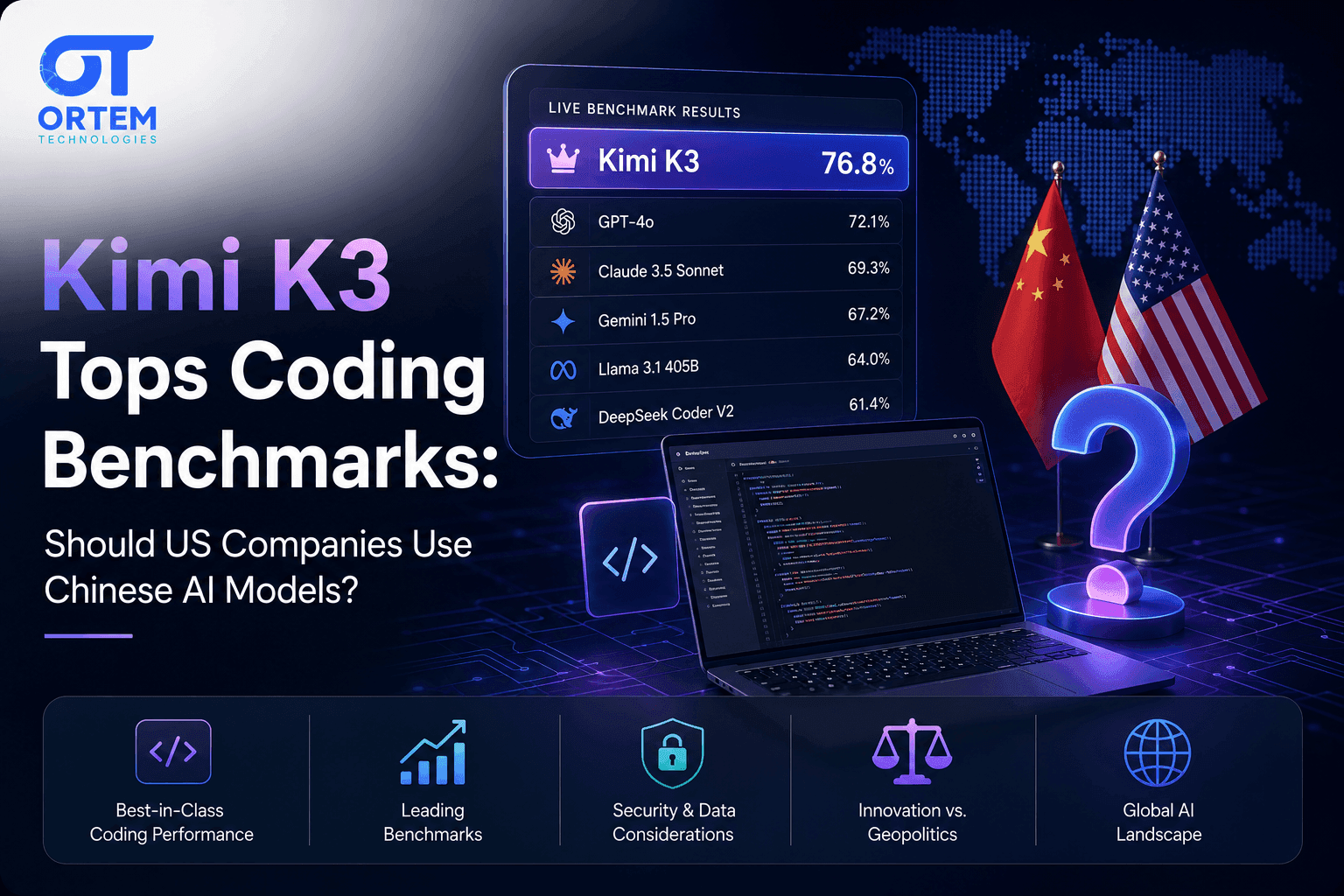
Moonshot AI's Kimi K3 topped Arena.ai's Frontend Code Arena in July 2026, beating US flagship models on that benchmark — the capability gap is real and closing. For US companies the decision splits on deployment mode: calling a China-hosted API with business data raises serious data-governance, compliance, and (for government-adjacent work) legal problems; self-hosting open-weight Chinese models on US infrastructure eliminates the data-transit issue but still requires license review, security evaluation, and customer-contract checks. Regulated industries and government contractors should default to US-vendor or self-hosted US-infrastructure options. Ortem Technologies helps clients run exactly this evaluation as part of LLM integration scoping.
Chinese AI models — from labs like Moonshot AI (Kimi), DeepSeek, Alibaba (Qwen), and Zhipu — are now benchmark-competitive with US flagships: Kimi K3 topped a major frontend-coding leaderboard in July 2026 with a 76% pairwise win rate. For US businesses the question has shifted from "are they good enough?" to "under what deployment and compliance conditions can we use them?"
Next Best Reads
Continue your research on AI Engineering
These links are chosen to move readers from general education into service understanding, proof, and buying-context pages.
AI & ML Solutions
Move from architecture reading into real model deployment, MLOps, and production AI pipelines.
Explore AI servicesLLM Integration
Integrate large language models into your product — RAG, fine-tuning, copilots, and APIs.
Explore LLM serviceAI Platform Case Study
See a production AI system with real data architecture, model integration, and launch outcomes.
Read case studyMoonshot AI's Kimi K3 took the top spot on Arena.ai's Frontend Code Arena this month, posting a 76% pairwise win rate and finishing ahead of the current US flagships on that benchmark. Set aside the geopolitics for a moment and register the technical fact: Chinese labs now ship frontier-competitive models, sometimes at aggressive prices, sometimes with open weights.
Now bring the geopolitics back, because if you run a US company, "is the model good?" is the wrong first question. The right one: under what deployment conditions could you use it at all? Here is the framework we walk clients through.
The distinction that does most of the work: API vs open weights
China-hosted API. Your prompts — potentially customer records, proprietary code, strategy documents — transit to infrastructure under Chinese jurisdiction, where national-security law provides broad governmental data access regardless of the vendor's privacy policy. For HIPAA-covered entities (no BAA available), financial firms with data-residency obligations, companies with enterprise DPAs promising controlled processing, and anything government-adjacent, this mode is effectively disqualifying. For a hobby project or public-data workload, the calculus is looser — but most businesses are not that.
Self-hosted open weights. Download the weights, run them on your own US infrastructure (or your cloud tenancy). No data is transmitted to the developer. The primary risk — data transit and jurisdiction — disappears entirely. What remains is ordinary diligence, listed below.
Most of the headline risk lives in the first mode. Most of the capturable value lives in the second.
Diligence checklist for self-hosted Chinese open-weight models
- License review. Open-weight is not open-source; several Chinese model licenses carry commercial-use conditions or restrictions. Read them like contracts, because they are.
- Behavioral evaluation. Run the model against your evaluation set — for capability, and for high-stakes uses, adversarial testing for unexpected behaviors. This is the same harness discipline from our multi-model strategy guide; the harness does not care where a model was trained.
- Customer-contract sweep. Some enterprise DPAs and security questionnaires ask about model provenance. Know your answer before your customer asks.
- Procurement honesty. If you sell into government, healthcare, or finance, disclose model provenance where expected. Surprise is the failure mode.
Sector defaults
| Sector | Default posture |
|---|---|
| Federal / government contractors | US vendors only; procurement rules govern |
| Healthcare (PHI) | US-vendor API with BAA, or self-hosted on controlled infra — see our HIPAA practice |
| Financial services | US-vendor or self-hosted; document vendor management |
| General SaaS / commercial | Self-hosted open weights viable with the checklist above |
| Public-data tools, research | Widest latitude; ordinary evaluation applies |
The strategic point most coverage misses
Kimi K3's benchmark win is not primarily a procurement question — it is pricing leverage. Frontier-competitive open-weight alternatives, wherever they originate, discipline US vendor pricing and strengthen every buyer's negotiating position. You capture that leverage simply by keeping your architecture multi-model: an abstraction layer and an evaluation harness mean adding or dropping any model — American or Chinese — is a config change plus a test run, not a bet-the-product decision.
Benchmark leadership rotates monthly. Architecture that treats models as swappable is the only position that wins every rotation.
The bottom line
Chinese models are now genuinely good, and pretending otherwise is not a strategy. Neither is ignoring jurisdiction. The framework is short: never send regulated or sensitive data to China-hosted APIs; capture open-weight value through self-hosting on infrastructure you control, gated by license, evaluation, and contract review; and keep your stack multi-model so capability news — from any country — is leverage, not disruption.
We run model evaluations, build self-hosted and multi-model deployments, and handle the compliance scoping around them. See our LLM integration services and outsourced development practice, or book a free consultation to run this framework against your specific stack.
About Ortem Technologies
Ortem Technologies is a premier custom software, mobile app, and AI development company. We serve enterprise and startup clients across the USA, UK, Australia, Canada, and the Middle East. Our cross-industry expertise spans fintech, healthcare, and logistics, enabling us to deliver scalable, secure, and innovative digital solutions worldwide.
Get the Ortem Tech Digest
Monthly insights on AI, mobile, and software strategy - straight to your inbox. No spam, ever.
Sources & References
- 1.Top Tech News, July 17 2026 - Tech Startups
- 2.LLM Integration Services - Ortem Technologies
About the Author
Director – AI Product Strategy, Development, Sales & Business Development, Ortem Technologies
Praveen Jha is the Director of AI Product Strategy, Development, Sales & Business Development at Ortem Technologies. With deep expertise in technology consulting and enterprise sales, he helps businesses identify the right digital transformation strategies - from mobile and AI solutions to cloud-native platforms. He writes about technology adoption, business growth, and building software partnerships that deliver real ROI.
Frequently Asked Questions
- For most commercial use, yes — there is no blanket prohibition on using Chinese-developed models in 2026. Restrictions concentrate at the edges: federal agencies and many government contractors face procurement rules against certain Chinese AI vendors, some states restrict specific apps on government devices, and defense-adjacent work is effectively off-limits. Commercial companies' real constraints are usually contractual (customer data-processing agreements) and regulatory (HIPAA, GLBA, SOC 2 commitments) rather than statutory.
- The core issue is data transit and jurisdiction: prompts sent to a China-hosted API — which may include customer data, proprietary code, or business strategy — are processed under Chinese jurisdiction, where national-security law grants the government broad data-access authority. That is typically incompatible with HIPAA, financial-services obligations, many enterprise DPAs, and any government-adjacent work, regardless of the vendor's stated privacy policy.
- Substantially. Running an open-weight model (downloaded weights) on your own US-based infrastructure means no data is transmitted to the model's developer — the primary risk vanishes. Remaining diligence: license terms (some restrict commercial use or add conditions), security evaluation of the model itself (backdoor and behavior testing for high-stakes uses), customer-contract review, and honest procurement disclosure where customers or regulators expect it.
- Benchmark leadership is a reason to evaluate, not to migrate. Run it against your own evaluation set like any other candidate model — task-level performance routinely diverges from leaderboard rank. If it wins on your tasks, the deployment-mode question above (API vs self-hosted) decides whether and how you can actually use it. For most US companies with compliance obligations, self-hosted or US-hosted inference of open-weight models is the only viable mode.
- Default to US-vendor APIs or self-hosted open-weight models on infrastructure you control, and document the decision. HIPAA-covered entities need BAAs with every processor touching PHI — unavailable from China-hosted APIs. Financial firms face similar data-residency and vendor-management obligations. The performance delta between top US and Chinese models is nowhere near large enough to justify a compliance exposure in these sectors.
Stay Ahead
Get engineering insights in your inbox
Practical guides on software development, AI, and cloud. No fluff — published when it's worth your time.
Ready to Start Your Project?
Let Ortem Technologies help you build innovative software solutions for your business.
You Might Also Like
Hire AI Developers in 2026: Rates, Vetting, and Engagement Models That Work
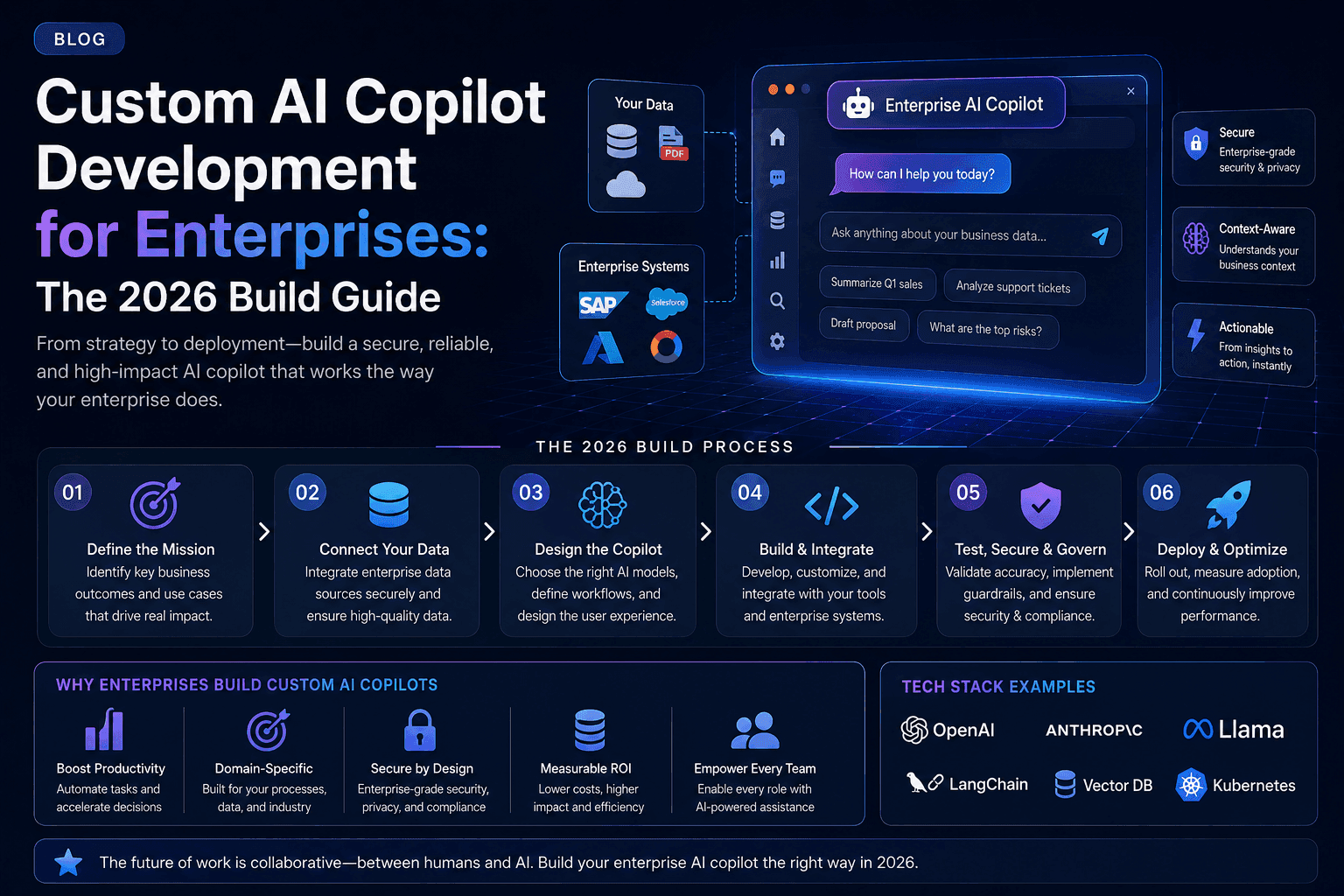
Custom AI Copilot Development for Enterprises: The 2026 Build Guide