
How Long Does AI Development Take in 2026? Honest Timelines by Project Type
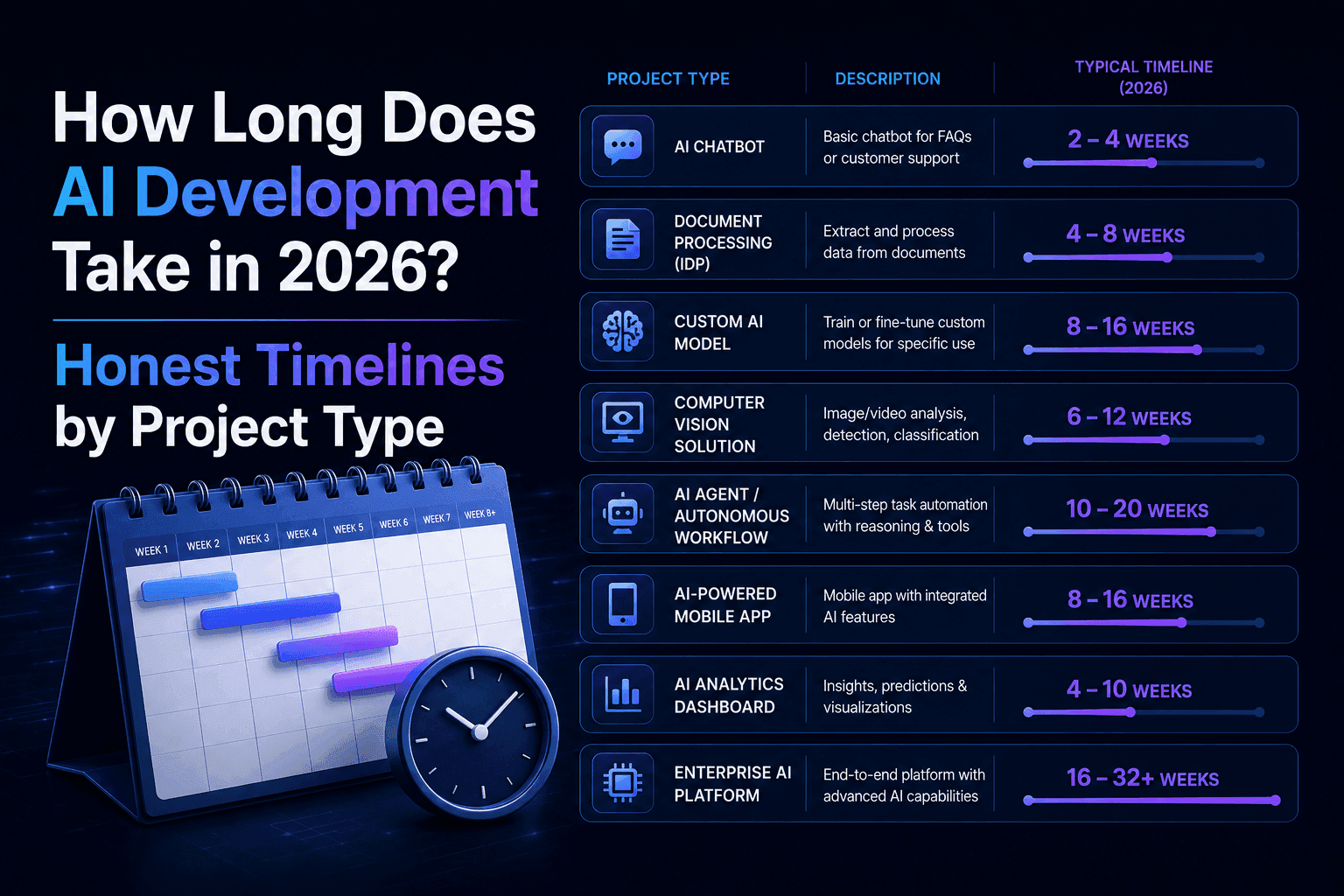
In 2026, an AI feature added to existing software takes 3-6 weeks, a grounded chatbot 4-8 weeks, an AI agent or enterprise copilot 8-16 weeks, and a custom or fine-tuned model product 16-24+ weeks. The biggest schedule variable is not the AI — it is data readiness and integration access. Projects slip when source data is messy or the client cannot grant system access quickly. Ortem Technologies LLC de-risks timelines with a one-week discovery that tests data quality before committing dates.
An AI development timeline spans discovery, data preparation, build, evaluation, integration, and rollout. Unlike traditional software, two phases dominate the variance: data preparation (finding, cleaning, and connecting the data the AI needs) and evaluation (proving the system meets an accuracy bar before real users touch it).
Next Best Reads
Continue your research on AI Engineering
These links are chosen to move readers from general education into service understanding, proof, and buying-context pages.
AI & ML Solutions
Move from architecture reading into real model deployment, MLOps, and production AI pipelines.
Explore AI servicesLLM Integration
Integrate large language models into your product — RAG, fine-tuning, copilots, and APIs.
Explore LLM serviceAI Platform Case Study
See a production AI system with real data architecture, model integration, and launch outcomes.
Read case study"How long will it take?" deserves a better answer than "it depends." After shipping AI systems across support, documents, vision, and voice, the honest 2026 ranges cluster tightly by project shape — and the causes of slippage are so consistent they are predictable.
Timeline at a glance
| Project type | Timeline | Where the time goes |
|---|---|---|
| AI feature (search, summarization) | 3-6 weeks | Discovery, build, evaluation |
| Grounded chatbot | 4-8 weeks | Retrieval pipeline, brand-safe prompting, rollout |
| AI agent or enterprise copilot | 8-16 weeks | Integration count, permission complexity, guarded rollout |
| Custom or fine-tuned model | 16-24+ weeks | Data collection, labeling, training cycles, domain evaluation |
Timelines by project type
AI feature in existing software: 3-6 weeks. Semantic search, summarization, smart categorization. One week discovery, two to three weeks build, the rest evaluation and rollout. The SaaS retrofit guide covers the architecture that keeps these fast.
Grounded chatbot: 4-8 weeks. Retrieval over your documentation, brand-safe prompting, escalation paths, deflection tracking. The demo exists by day ten; the remaining weeks make it survive real customers.
AI agent or enterprise copilot: 8-16 weeks. The range is driven almost entirely by integration count and permission complexity — the reasons explained in our chatbot vs agent comparison. Guarded rollout with confirmation gates consumes the final weeks, and skipping it is how agents make headlines for the wrong reasons.
Custom or fine-tuned model product: 16-24+ weeks. Data collection and labeling, training cycles, and domain evaluation stack on top of everything above. Most teams should exhaust the API-based options first — the fine-tuning decision guide shows why.
The three schedule killers
1. Data readiness. The champion. "Our data is in the CRM" becomes four exports, two abandoned fields, and a folder of PDFs nobody mentioned. A one-week data audit before dates are committed converts this from a mid-project crisis into a line item.
2. Access and approvals. The AI team is ready; the API credentials are in a security review queue. On enterprise projects, requesting all system access in week one — with security review run in parallel to early build — saves a month by itself.
3. Scope drift. The week-three demo impresses, stakeholders add requests, and the 6-week feature becomes a 14-week program. The discipline that prevents it is the thin-slice method: ship the narrow slice on schedule, bank the win, widen from evidence.
How we compress without cutting corners
Reusable foundations (evaluation harnesses, gateway patterns, integration templates) remove the weeks teams spend rediscovering infrastructure. Parallel tracks — data pipeline, application build, and security review running simultaneously — remove idle time. And fixed two-week increments with a reviewed metric keep scope honest. What we refuse to compress: evaluation. It is 10-15% of the schedule and 100% of the difference between a launch and an apology.
How to set an internal deadline that will actually hold
Work backward from the timeline bands above using your actual project type, not the fastest case you have heard about from a vendor's marketing page.
Add a buffer week for any project requiring access to a system your IT or security team has not previously granted API credentials for — that approval step is outside engineering's control and is the single most common source of a missed date that has nothing to do with the AI work itself.
Communicate the metric-based go/no-go checkpoint at the midpoint of the timeline internally, so stakeholders are prepared for a data-driven scope conversation rather than expecting a fixed feature list on a fixed date regardless of what the interim evaluation shows.
What "done" looks like at each stage
A feature is done when it passes its evaluation threshold in staging with real data, not when the demo works once. A chatbot is done when it has run in a monitored soft launch against real customer traffic for at least a week without unresolved escalations.
An agent is done when it has completed its guarded rollout period with confirmation gates and the false-positive escalation rate is low enough to relax them. Treating any earlier point as "done" is how projects that shipped on schedule still generate incidents in their first month of real use.
Planning an AI initiative for this year? Ortem Technologies will run the one-week discovery, test your actual data, and give you dates worth planning around. Get your timeline.
For how timeline fits with cost and service scope, see our complete guide to AI development services.
About Ortem Technologies
Ortem Technologies is a premier custom software, mobile app, and AI development company. We serve enterprise and startup clients across the USA, UK, Australia, Canada, and the Middle East. Our cross-industry expertise spans fintech, healthcare, and logistics, enabling us to deliver scalable, secure, and innovative digital solutions worldwide.
Get the Ortem Tech Digest
Monthly insights on AI, mobile, and software strategy - straight to your inbox. No spam, ever.
Sources & References
- 1.AI PoC to Production Guide - Ortem Technologies
- 2.AI & ML Solutions - Ortem Technologies
About the Author
Editorial Team, Ortem Technologies
The Ortem Technologies editorial team brings together expertise from across our engineering, product, and strategy divisions to produce in-depth guides, comparisons, and best-practice articles for technology leaders and decision-makers.
Frequently Asked Questions
- A production chatbot grounded in your documentation takes 4-8 weeks: one week of discovery and data audit, two to three weeks building retrieval and prompt pipelines, and the remainder on evaluation, integration into your site or app, and a monitored soft launch. Demos take days; the gap between demo and production is where the weeks go.
- AI agents run 8-16 weeks depending on how many systems they touch. Each integration — CRM, billing, ticketing — adds setup, permission handling, and failure testing. Agents also need longer evaluation than chatbots because actions are higher-stakes than answers: expect several weeks of guarded rollout with confirmation gates before full autonomy.
- Three causes dominate: data that turned out messier than anyone admitted (weeks of pipeline work), slow access grants to client systems (integration idles while security reviews credentials), and scope drift from demo-driven excitement. Notably rare: the AI itself. Model capabilities in 2026 are seldom the bottleneck.
- Yes, when three things are true: data is clean and accessible on day one, the team has shipped the same pattern before, and the first release is scoped as a thin slice rather than the full vision. Under those conditions a feature can ship in 2-3 weeks. Compressing by skipping evaluation is the false shortcut — it converts schedule risk into production incidents.
- Surprisingly little — often under 15% of total schedule. Model selection and prompt engineering move fast because the frontier models are already trained and API-accessible. The majority of timeline sits in data preparation, integration with existing systems, evaluation harness construction, and security or permission review, none of which are AI-specific engineering in the traditional sense.
- Marginally, not fundamentally. Claude, GPT, and Gemini APIs are functionally similar enough that switching providers mid-project is a days-long change, not a rebuild, provided the application was architected with a model-agnostic gateway layer. Provider choice affects cost and specific capability edge cases more than it affects timeline.
- Add two to four weeks to the standard ranges above for a company with no prior AI project experience — the extra time covers internal alignment on the success metric, data access approvals moving through unfamiliar processes, and one additional review cycle before stakeholders are comfortable signing off on launch. This overhead largely disappears on a company's second and third AI projects.
Stay Ahead
Get engineering insights in your inbox
Practical guides on software development, AI, and cloud. No fluff — published when it's worth your time.
Ready to Start Your Project?
Let Ortem Technologies help you build innovative software solutions for your business.
You Might Also Like
How to Build a Production-Ready AI Agent with LangGraph in 2026

GPT-5.5 vs Claude Opus 4.7 vs Gemini 3.1 Pro: Which AI Model Should You Build With in 2026?
