How to Build an LLM Evaluation Framework for AI Apps and Agents: Metrics, Judges and Release Gates
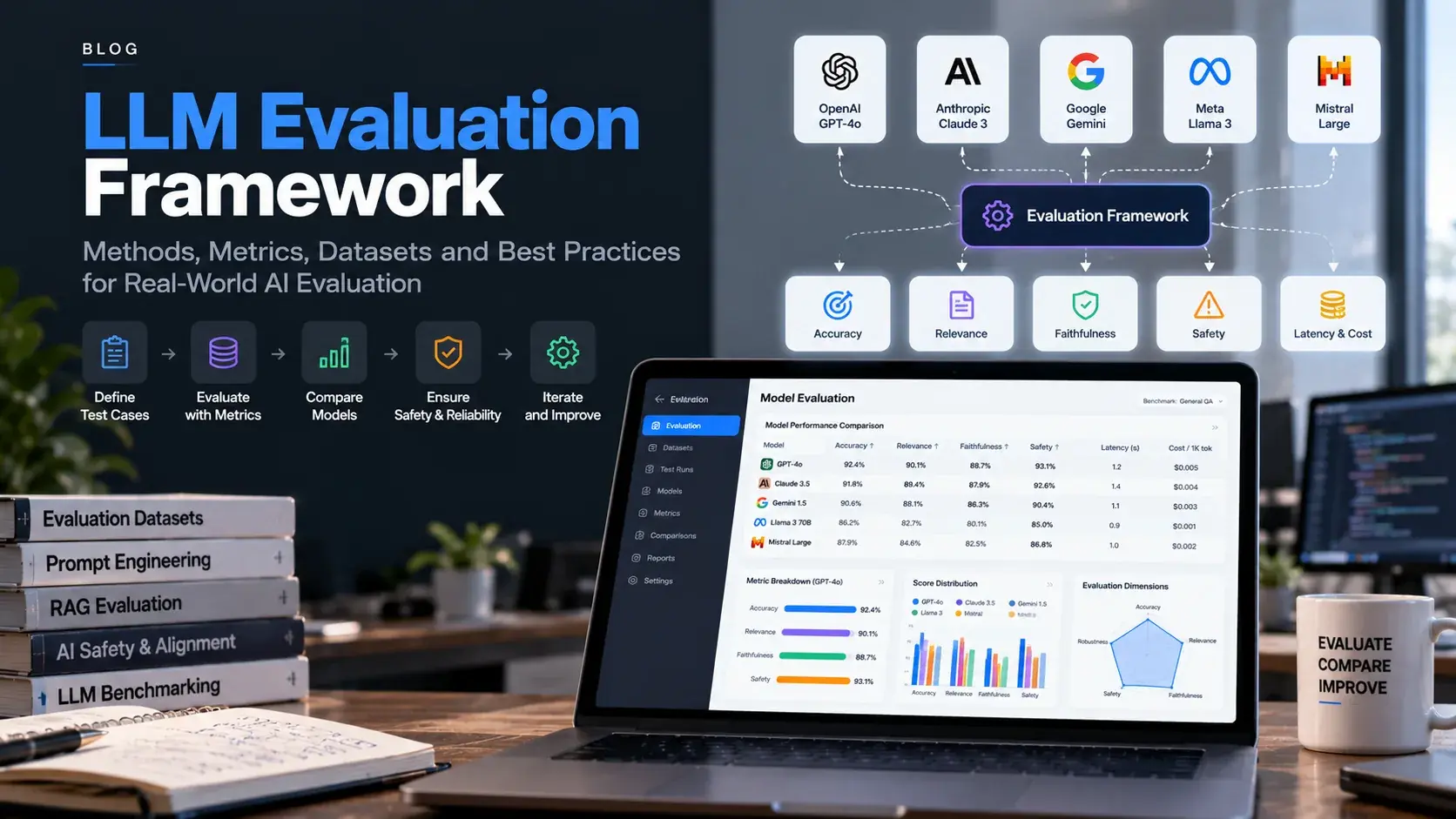
An LLM evaluation framework is a repeatable process for measuring whether an AI application gives correct, safe and useful outputs. It has five parts: a test dataset drawn from real use cases, metrics such as task success, faithfulness and tool-call accuracy, graders that combine code checks, LLM-as-a-judge and human review, release gates that block regressions in CI, and production monitoring on live traffic.
Next Best Reads
Continue your research on AI Engineering
These links are chosen to move readers from general education into service understanding, proof, and buying-context pages.
AI & ML Solutions
Move from architecture reading into real model deployment, MLOps, and production AI pipelines.
Explore AI servicesLLM Integration
Integrate large language models into your product — RAG, fine-tuning, copilots, and APIs.
Explore LLM serviceAI Platform Case Study
See a production AI system with real data architecture, model integration, and launch outcomes.
Read case studyAn LLM evaluation framework is a repeatable way to measure whether your AI application gives correct, safe and useful answers. Public benchmarks measure models. Your users care about your application: your prompts, your data, your tools and your edge cases.
This guide shows how to build an evaluation framework for RAG applications and AI agents, from the first test case to release gates and production monitoring.
Why Benchmarks Are Not Enough
Leaderboards such as Stanford's HELM and harnesses such as EleutherAI's LM Evaluation Harness are useful for choosing a model. They do not tell you:
- Whether your retrieval finds the right documents
- Whether your prompt handles your users' real questions
- Whether your agent picks the right tool with the right arguments
- Whether a prompt change fixed one case and broke ten others
That is what an application-level evaluation framework is for.
The Five Parts of an Evaluation Framework
1. A test dataset from real use cases
Your test set is the most valuable part of the framework. Build it from:
- Real user questions from logs, support tickets or interviews
- Known failure cases that caused bugs or complaints
- Edge cases: ambiguous questions, missing data, out-of-scope requests
- Adversarial cases: prompt injection attempts and policy violations
For each case, store the input, the expected outcome or reference answer, and any context the system should use. Start with 50 to 100 cases and grow from there. Every production bug should become a new test.
2. Metrics that match the task
Pick metrics for what your application actually does.
| Application | Useful metrics |
|---|---|
| Question answering | Correctness, answer relevance, completeness |
| RAG | Faithfulness to context, context precision, context recall |
| Summarisation | Coverage of key points, factual consistency, length |
| Extraction | Field-level accuracy, schema validity |
| AI agents | Task success, tool-call accuracy, steps taken, policy compliance |
| All | Latency, cost per request, refusal rate, safety |
Keep the list short. Five well-chosen metrics beat twenty that nobody reads.
3. Graders: code first, judges second, humans to calibrate
Use the cheapest grader that works.
Code-based checks are fast, free and deterministic. Use them for anything you can test exactly: JSON schema validity, required fields, exact matches, banned phrases, citations present, tool names and arguments.
LLM-as-a-judge scores open-ended qualities like relevance or faithfulness. Research on MT-Bench and Chatbot Arena found that strong LLM judges agreed with human preferences more than 80% of the time, about the same as humans agree with each other. The same work documented biases:
- Position bias: favouring the first answer in a pairwise comparison
- Verbosity bias: favouring longer answers
- Self-enhancement bias: favouring answers written by the same model
Reduce them by swapping answer order, scoring against a rubric rather than "which is better", and using a different model family as judge where you can.
Human review calibrates everything else. Label a sample by hand and check how often your judge agrees. If agreement is low, fix the rubric before trusting the scores.
4. Release gates in CI
Evaluations are only useful if they block bad releases. Run the test set on every change to prompts, models, retrieval or tools, and fail the build when scores drop.
Example gates a team might set, to be tuned to your own baseline:
- No drop in task success on the core test set
- Faithfulness above an agreed threshold on RAG cases
- Zero failures on safety and prompt-injection cases
- Latency and cost per request within budget
Track scores over time so you can see slow drift, not just sudden breaks.
5. Production monitoring
Your test set will never match real traffic exactly. After launch:
- Sample live conversations and score them with the same graders.
- Collect user feedback such as thumbs up or down, and review the negatives.
- Watch for drift in topics, languages and question types.
- Feed failures back into the test set.
Evaluating AI Agents
Agents take multiple steps and call tools, so you need to evaluate the path as well as the result.
- End state: Did the agent achieve the goal? Check the database row, the sent email or the created ticket, not just the final message.
- Tool selection: Did it choose the right tool at each step?
- Argument correctness: Were the tool arguments valid and sensible?
- Efficiency: How many steps, tokens and seconds did it take?
- Error handling: Did it recover from a failed tool call or ask for help?
- Permissions: Did it stay within what it was allowed to do?
Run each agent task several times. Agents are not deterministic, so a single pass can hide flaky behaviour. Report the success rate across runs.
For agents that take real actions, pair evaluation with human approval steps. Our guide to human-in-the-loop AI agent design covers the patterns.
LLM Evaluation Tools
You do not have to build everything from scratch.
| Tool | What it is good at |
|---|---|
| DeepEval | Open-source metrics and test runner, similar in feel to unit tests |
| Ragas | RAG-focused metrics such as faithfulness and context precision |
| Promptfoo | Prompt and model comparisons, regression tests and red-teaming in CI |
| LangSmith | Tracing, datasets and evaluations for LLM apps and agents |
| Inspect | Structured evaluations, including agent tasks, from the UK AI Security Institute |
| MLflow | Experiment tracking with LLM evaluation support |
| OpenAI Evals | Open-source framework and registry of evaluations |
| LM Evaluation Harness | Benchmarking models on standard academic tasks |
Most teams combine one metrics library, one tracing tool and their own CI scripts.
Governance: Make It Auditable
If you work in a regulated industry, keep records of what you tested, when, and with which model version. The NIST AI Risk Management Framework includes a "Measure" function that maps well to an evaluation framework: defined metrics, documented tests and ongoing monitoring.
A 30-Day Plan to Get Started
- Week 1: Collect 50 real test cases and write down what a good answer looks like.
- Week 2: Add code-based checks and one LLM-judged metric. Calibrate the judge on 30 hand-labelled cases.
- Week 3: Run the suite in CI on every prompt or model change.
- Week 4: Start sampling production traffic and add failures to the test set.
Evaluation pairs naturally with observability. Read our guide to the AI agent observability stack, or talk to us about AI agent development with evaluation built in from day one.
About Ortem Technologies
Ortem Technologies is a premier custom software, mobile app, and AI development company. We serve enterprise and startup clients across the USA, UK, Australia, Canada, and the Middle East. Our cross-industry expertise spans fintech, healthcare, and logistics, enabling us to deliver scalable, secure, and innovative digital solutions worldwide.
Get the Ortem Tech Digest
Monthly insights on AI, mobile, and software strategy - straight to your inbox. No spam, ever.
Sources & References
- 1.Judging LLM-as-a-Judge with MT-Bench and Chatbot Arena (Zheng et al.) - arXiv
- 2.DeepEval documentation - Confident AI
- 3.Ragas documentation - Ragas
- 4.Promptfoo documentation - Promptfoo
- 5.Inspect evaluation framework - UK AI Security Institute
- 6.Language Model Evaluation Harness - EleutherAI
- 7.Holistic Evaluation of Language Models (HELM) - Stanford CRFM
- 8.AI Risk Management Framework - NIST
About the Author
Technology Division, Ortem Technologies
The Ortem AI Research Team is a cross-functional group of ML engineers, data scientists, and software architects embedded across our product, platform, and client delivery divisions. The team researches and evaluates emerging technologies — including large language models, agentic AI systems, computer vision, and MLOps infrastructure — translating complex concepts into actionable guidance for engineering leaders and enterprise decision-makers. Each article published under this byline is the result of collaborative investigation: real-world experimentation, architecture reviews, and performance benchmarking drawn from live client projects and internal R&D initiatives. The team is committed to publishing technically rigorous, vendor-neutral content that helps organisations cut through AI hype and make confident, ROI-driven technology decisions.
Frequently Asked Questions
- An LLM evaluation framework is a structured, repeatable way to test an AI application's outputs. It defines the test data, the metrics, how each output is scored, the thresholds a release must meet, and how live traffic is monitored after launch.
- Use metrics that match the task. Common ones are task success, correctness against a reference answer, faithfulness to retrieved context, answer relevance, context precision and recall for RAG, tool-call accuracy for agents, safety and policy compliance, latency and cost per request.
- It can be, with care. Research on MT-Bench found strong LLM judges agreed with human preferences over 80% of the time, similar to agreement between humans, but also showed position, verbosity and self-enhancement biases. Calibrate any judge against human labels on your own data before trusting it.
- Evaluate both the outcome and the path. Check whether the agent reached the correct end state, whether it chose the right tools with valid arguments, how many steps and tokens it used, whether it handled errors, and whether it stayed within permissions. Run each task several times, because agents are not deterministic.
- Popular options include DeepEval and Ragas for metrics, Promptfoo for prompt and regression testing in CI, LangSmith and Arize Phoenix for tracing and evaluation, Inspect for structured evaluations, and the EleutherAI LM Evaluation Harness and Stanford HELM for model benchmarking.
- Start with 50 to 100 cases that cover your main tasks and known failure modes, then grow to several hundred as you learn. Coverage of real user scenarios matters more than raw size, and every production bug should become a new test case.
Stay Ahead
Get engineering insights in your inbox
Practical guides on software development, AI, and cloud. No fluff — published when it's worth your time.
Ready to Start Your Project?
Let Ortem Technologies help you build innovative software solutions for your business.
You Might Also Like
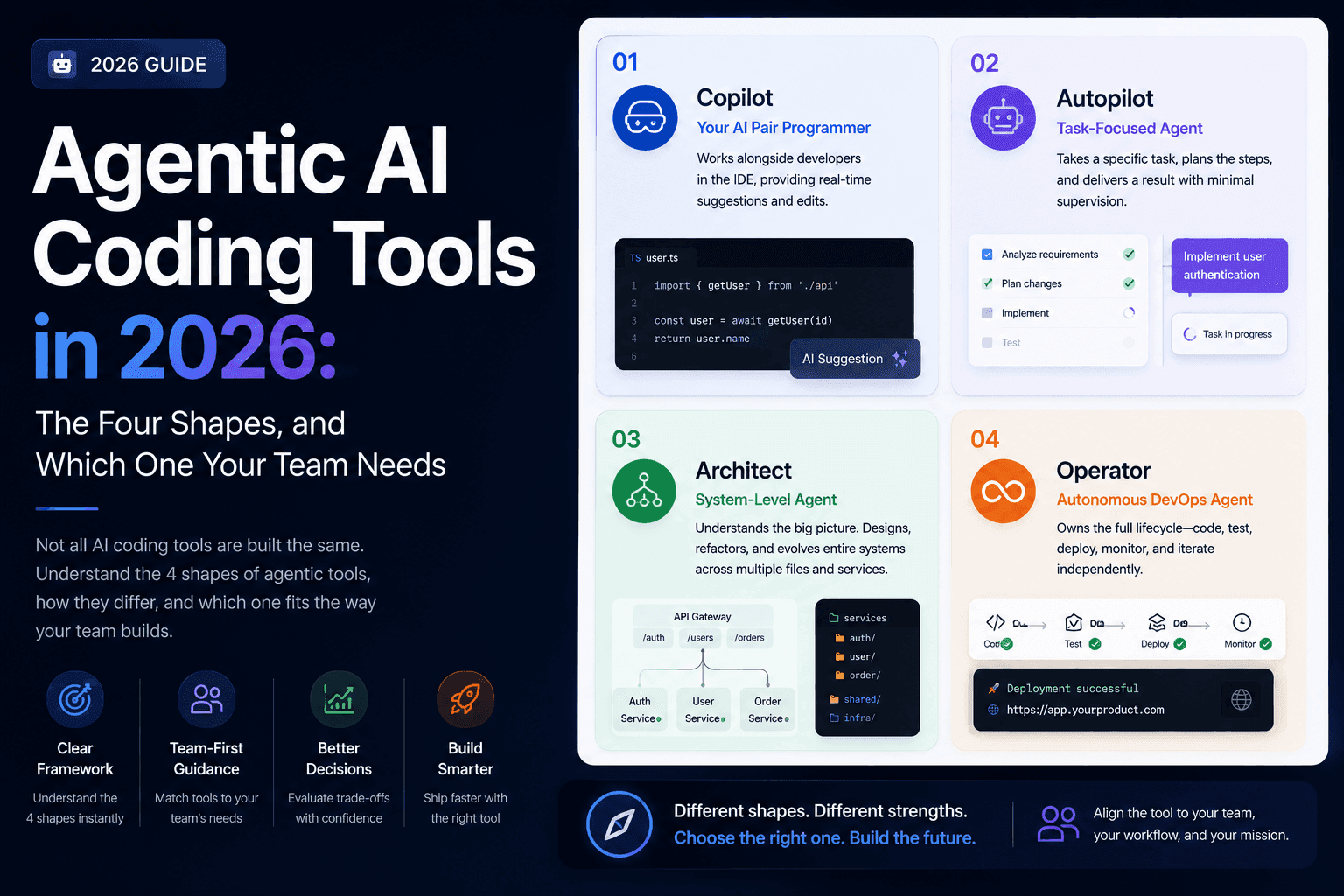
Agentic AI Coding Tools in 2026: The Four Shapes, and Which One Your Team Needs

v0 vs Google Stitch: One Ends at a Design, the Other at a Deployed URL