Agentic AI Coding Tools in 2026: The Four Shapes, and Which One Your Team Needs
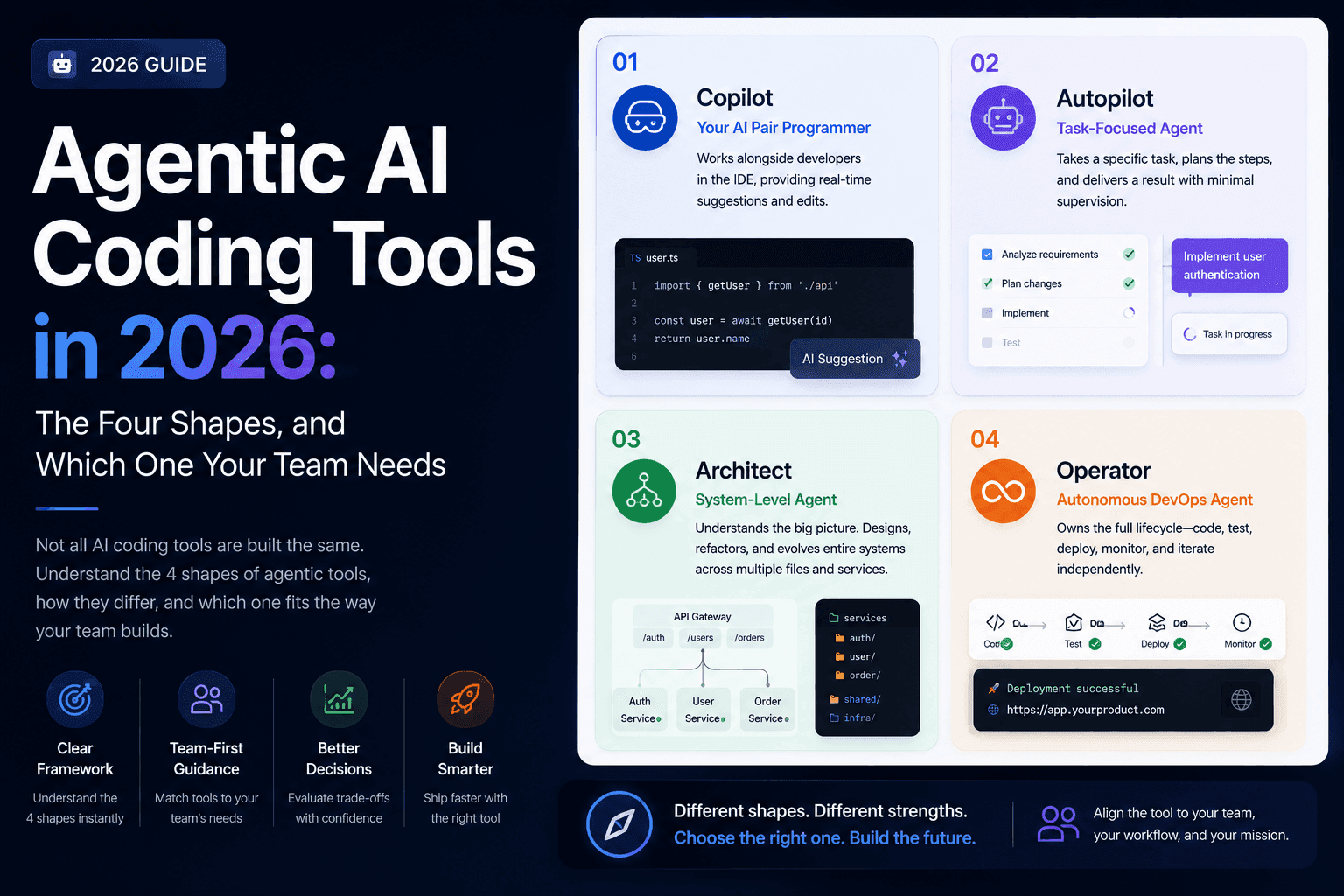
Agentic AI coding tools take a goal, plan the steps, run them, and check their own work, instead of completing the line you are typing. In 2026 they come in four shapes: terminal agents that run in your shell with full repo access (Claude Code, Codex CLI, Aider, OpenCode, Gemini CLI), IDE agents that work inside the editor while you stay in the loop (Cursor, Windsurf, GitHub Copilot agent mode, JetBrains AI Assistant), async cloud agents that take a ticket and open a pull request without you watching (Devin, Codex cloud, Claude Code Remote, Replit Agent), and review agents that read diffs rather than write them (CodeRabbit, Greptile, Graphite). Terminal agents suit engineers who want a power tool on a repo they know. Async agents suit backlogs of small, well-specified tickets. Most teams that get real leverage run two categories, not one.
Next Best Reads
Continue your research on AI Engineering
These links are chosen to move readers from general education into service understanding, proof, and buying-context pages.
AI & ML Solutions
Move from architecture reading into real model deployment, MLOps, and production AI pipelines.
Explore AI servicesLLM Integration
Integrate large language models into your product — RAG, fine-tuning, copilots, and APIs.
Explore LLM serviceAI Platform Case Study
See a production AI system with real data architecture, model integration, and launch outcomes.
Read case studyAlmost every tool in the developer market added the word "agentic" during 2026. Most of them did not change what they do. The label now covers autocomplete with a longer context window, chat panels that can edit two files, and genuine autonomous agents that take a Jira ticket and open a pull request — and buyers cannot tell them apart from the landing pages.
The distinction that matters: an assistant completes what you are typing, an agent decides what to do next. The practical test is whether the tool can run a command, read the failure output, and change its own plan on the basis of what it read. Everything that cannot do that is an assistant with better marketing.
This guide sorts the category into the four shapes that actually behave differently, then covers how to choose between them for a real team.
The autonomy ladder
Before the tool list, the four rungs. Vendors rarely tell you which one they are on.
Completion. Predicts the next tokens in your file. No tools, no execution, no plan. GitHub Copilot's original product.
Chat with edits. Answers questions and applies multi-file changes you approve one at a time. It has read access to your codebase, but you still decide every step.
Supervised agency. Takes a goal, forms a plan, executes it against real tools — reading files, running tests, invoking the build — and reports back. You watch, interrupt, and redirect. This is where Claude Code, Cursor's agent mode and Codex CLI operate, and it is where the productive majority of 2026 AI-assisted engineering actually happens.
Delegated autonomy. Takes a ticket, works without a watcher, and returns a pull request. Devin, Codex cloud runs, Claude Code Remote and Replit Agent are here.
The jump from supervised to delegated is much larger than the jump from chat to supervised. Supervised agency fails visibly and cheaply — you see the wrong turn and stop it. Delegated autonomy fails invisibly and expensively, arriving as a plausible-looking diff built on a misread of the requirement. That asymmetry, not the benchmark difference, is why most teams that adopt delegated agents keep them on a narrow class of work.
Shape 1: Terminal agents
Claude Code, Codex CLI, Aider, OpenCode, Gemini CLI, Meta Muse Code.
These run in your shell with access to the repository, the test suite, git and whatever else is on your PATH. No editor integration, no UI to learn — the interface is a prompt and the file system.
Terminal agents win on the work that requires reading a lot of existing code before writing any: debugging across service boundaries, tracing why a test is flaky, migrating a pattern through forty files, understanding a module nobody on the current team wrote. Full repository access is the whole advantage. The agent finds the convention by reading the code rather than being told about it.
Claude Code leads this category on autonomous multi-file reasoning, and Claude Code Remote posts the strongest published SWE-bench Verified result at 87.6%. Codex CLI is open source, runs locally and hands off to OpenAI's cloud execution when a task needs it.
Aider is the veteran and remains the most git-native of the group, committing each change so you can bisect the agent's work like any other history. Meta's Muse Code, released in August 2026, targets large repositories specifically — the pitch is repo-scale context rather than per-task cleverness.
The cost of this shape is that it demands a competent operator. A terminal agent given a vague goal on an unfamiliar codebase produces confident, wrong, large diffs.
Shape 2: IDE agents
Cursor, Windsurf, GitHub Copilot agent mode, JetBrains AI Assistant, Google Antigravity.
The agent lives in the editor. You keep your cursor, your file tree and your debugger, and the agent works alongside you with the same view of the project you have.
This shape suits active development sessions — building a feature you are thinking through, where you want to steer every few minutes rather than hand over the whole task. The tight loop is the point. You see the diff appear, reject the half you disagree with, and keep going without leaving the editor.
Cursor is the category leader and crossed $1B ARR. Windsurf now sits inside OpenAI after the acquisition. GitHub Copilot remains the safest procurement answer for an enterprise that already has GitHub Enterprise, because the compliance and data-residency questions are already answered.
Google Antigravity shipped a 2.0 in May 2026 that added a CLI and subagents, moving it partly into the terminal category; its pricing runs from a free individual tier up through Google AI Pro at $19.99 to Ultra plans at $99.99 and $199.99 — the widely quoted $249.99 tier was retired at I/O in May 2026.
Shape 3: Async cloud agents
Devin, Codex cloud, Claude Code Remote, Replit Agent, Grok Build.
You file a task. The agent works on infrastructure you do not manage. A pull request appears. Nobody watched.
This is the shape that gets oversold. It works, but on a narrower class of work than the demos imply: small, well-specified changes in a codebase with real test coverage and consistent conventions. Dependency bumps, adding a field through an existing CRUD path, writing tests for an untested module, mechanical migrations.
The moment the ticket requires knowing something that is not written down anywhere in the repository, the async agent produces a confident wrong answer and you find out at review time.
Pricing reflects the compute. Devin runs from $20 per month at the entry tier through $200 per month for Max, with team plans layering a per-seat charge on top. That is not expensive per ticket if the tickets close. It is very expensive if they do not, because you paid for the compute and then paid an engineer to read the diff and reject it.
xAI's Grok Build, released in July 2026 alongside Grok 4.5, is the newest serious entry in this shape.
The honest framing: async agents are worth it when you have a backlog of small tickets nobody wants and a test suite good enough to catch a bad diff. If either half is missing, the economics do not work.
Shape 4: Review agents
CodeRabbit, Greptile, Graphite Diamond, GitHub Copilot code review.
The category that emerged because of the other three. When agents write more diffs, review becomes the bottleneck, and a human reviewer facing four times the volume reviews all of it worse.
Review agents read pull requests and comment. The good ones catch the specific failure modes that agent-written code produces: a plausible-looking implementation that duplicates a helper that already exists three directories over, error handling for a condition that cannot occur, a test that asserts the implementation rather than the behaviour.
Teams adopting the other three shapes at any scale should budget for this one at the same time. Skipping it is how a team ships more code and more incidents in the same quarter.
How to choose
Not by benchmark. SWE-bench Verified measures whether a model can resolve a real GitHub issue in a Python repository with a passing test as the oracle. That is a genuine measurement and it correlates with real capability, but it does not measure the constraint that will actually bite you, which is context: how much of your system the agent has to be told versus how much it can read.
Ask these instead.
How much of the requirement is written down? If the ticket makes sense only to someone who sat in the meeting, an async agent will fail on it regardless of model quality. Use a supervised agent, because the human in the loop is supplying the missing context.
How good is your test suite? Delegated autonomy is only as safe as the oracle checking it. Weak tests mean every agent diff needs full human reading, which erases the reason you delegated.
Is the codebase consistent? Agents infer conventions by reading nearby code. A codebase with three competing patterns for the same thing produces agent output with three competing patterns, and often a fourth.
Where is your bottleneck? If engineers are slow inside the editor, an IDE agent. If they are slow understanding unfamiliar systems, a terminal agent. If the backlog of small work never gets done, an async agent. If pull requests sit for two days, a review agent. Teams buy the loudest tool rather than the one that unblocks them, and then measure no improvement.
What actually changed in 2026
Four things, worth knowing if your evaluation is more than a few months old.
The tool tier stopped being the differentiator — the model underneath did. Most serious agents now let you swap models, so the harness matters less than which frontier model you point it at.
Repository-scale context stopped being a research problem. Muse Code and the 2026 Claude and Gemini releases made whole-repo reasoning practical rather than a demo, which is what made terminal agents better than IDE agents at legacy work.
Pricing split into three shapes: seats, consumption, and compute. Consumption pricing means your best engineers cost the most to equip, which is the correct outcome and still surprises finance.
Review became a first-class category rather than a feature. That is the clearest signal about where the real constraint moved.
The bottom line
The question is not which agentic coding tool is best. It is which rung of the autonomy ladder your work belongs on, and most teams have work on several rungs at once — which is why the teams getting real leverage run a supervised agent and a review agent rather than betting everything on delegated autonomy.
Start with supervised agency, because it fails cheaply and teaches your team what these tools are actually good at. Add delegated autonomy only for the specific slice of your backlog that is well-specified and well-tested. Add review capacity before you need it, not after the incident.
At Ortem Technologies we build with agentic tooling on client engagements daily, and we help engineering teams work out which of these four shapes fits their codebase before they commit to a rollout. Talk to our AI engineering team | Discuss an agentic tooling rollout
For a head-to-head on the specific tools rather than the categories, see our Cursor vs Claude Code vs GitHub Copilot comparison, and for the organisational side, the AI coding agents team rollout playbook.
About Ortem Technologies
Ortem Technologies is a premier custom software, mobile app, and AI development company. We serve enterprise and startup clients across the USA, UK, Australia, Canada, and the Middle East. Our cross-industry expertise spans fintech, healthcare, and logistics, enabling us to deliver scalable, secure, and innovative digital solutions worldwide.
Get the Ortem Tech Digest
Monthly insights on AI, mobile, and software strategy - straight to your inbox. No spam, ever.
Sources & References
About the Author
Private 1:1 AI Tutor · Director of Sales & Business Development, Moksh Tech
Praveen Jha is a private 1:1 AI tutor and enterprise AI sales leader based in Ahmedabad, India. He teaches executives, founders and engineers to ship real work with ChatGPT, Claude, Cursor and Claude Code, and is an Oracle Certified Generative AI Professional and AWS Certified Solutions Architect. He wrote his articles here while Director of AI Product Strategy, Sales & Business Development at Ortem Technologies.
Frequently Asked Questions
- An assistant completes what you are typing. An agent takes a goal you state once, decides the sequence of steps itself, executes them against real tools — reading files, running the test suite, calling the package manager — and uses the results to decide what to do next. The practical test is whether the tool can run a command, read the failure, and change its own plan. If it can only produce text you then act on, it is an assistant.
- Rarely, and the marketing does not distinguish. Most tools labelled agentic still need scoped tasks and human review of every diff. Genuine assign-and-forget completion works on a narrow band of work: small, well-specified, well-tested changes in a codebase with good conventions. Outside that band, supervision is what makes them productive.
- A terminal agent with full repository access, because the binding constraint on legacy code is context rather than code generation. The agent needs to read the code that already exists to understand undocumented conventions. Async cloud agents struggle here — they get a ticket and a repo but not the tribal knowledge that makes the ticket make sense.
- No, and the volume argument runs the other way. A team shipping more diffs because agents write them needs more review capacity, not less. This is why review agents became their own category in 2026 — they triage the increased diff volume so human reviewers spend attention on the changes that matter.
- Three pricing shapes exist. Seat pricing (roughly $20 to $40 per developer per month) covers most IDE and terminal agents. Consumption pricing charges for tokens or agent-compute and scales with how hard you push it. Async autonomous agents price highest — Devin runs from $20 per month at the entry tier up to $500 per month for the top plans — because you are paying for the compute the agent burns while nobody is watching.
Stay Ahead
Get engineering insights in your inbox
Practical guides on software development, AI, and cloud. No fluff — published when it's worth your time.
Ready to Start Your Project?
Let Ortem Technologies help you build innovative software solutions for your business.
You Might Also Like
v0 vs Google Stitch: One Ends at a Design, the Other at a Deployed URL
Framer vs Lovable vs v0: The Category Question Nobody Asks First