
Computer Vision Development Services in 2026: What to Build and What It Costs
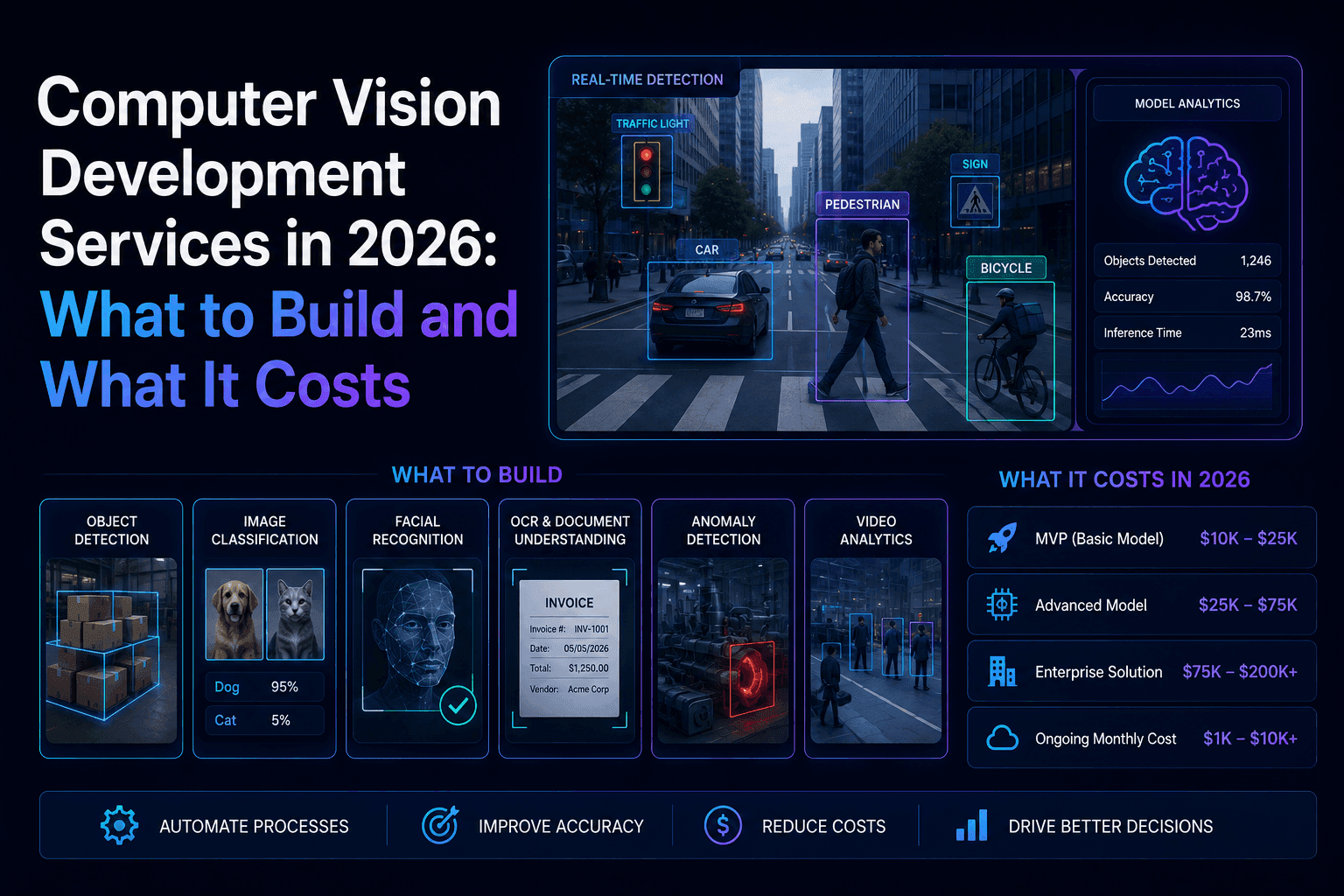
Computer vision development in 2026 splits into two tracks: vision-language models (VLMs) handle open-ended visual understanding with little or no training data, while trained detection models still win for high-speed, high-precision tasks like production-line inspection. Typical projects — visual QC, safety compliance monitoring, retail shelf analytics, visual document processing — cost $30,000-120,000, a fraction of the pre-VLM era because data labeling has shrunk from months to days. Ortem Technologies LLC builds both tracks, including edge deployments.
Computer vision development is building systems that extract decisions from images and video — defect detection, safety compliance, object counting, visual search. The 2026 stack pairs foundation vision-language models for flexible understanding with compact trained models for speed-critical detection, often deployed together on edge hardware.
Commercial Expertise
Need help with AI & Machine Learning?
Ortem deploys dedicated AI & ML Engineering squads in 72 hours.
Next Best Reads
Continue your research on AI & Machine Learning
These links are chosen to move readers from general education into service understanding, proof, and buying-context pages.
AI & ML Solutions
Move from concept articles to real implementation planning for copilots, RAG, automation, and analytics.
Explore AI servicesAI Agent Development
See how Ortem builds autonomous workflows, tool-using agents, and human-in-the-loop systems.
View agent serviceAI Product Case Study
Study a production AI platform with architecture, launch scope, and operating model context.
Read case studyFor a decade, computer vision projects had a reputation: six figures, six months, and a labeling team before the first result. Vision-language models broke that equation. In 2026, a system that answers "is anything wrong in this picture?" can be prototyped in a week — and the projects paying for themselves fastest are refreshingly unglamorous.
The two tracks at a glance
| VLM track (understanding) | Trained model track (speed) | |
|---|---|---|
| Best for | Open-ended questions, audits, analytics | Line-speed detection, precision counting |
| Training data needed | Near-zero, few-shot examples | Hundreds to thousands of labeled images |
| Cost | $30,000-70,000 | $60,000-120,000 (includes edge deployment) |
| Latency | Seconds via API | Milliseconds on-device |
| Where it deploys | Cloud | Edge hardware, often hybrid with cloud escalation |
The two-track stack of 2026
Track one: VLMs for understanding. Foundation models that answer open questions about images — "does this installation match the spec?", "which items are missing from this shelf?", "summarize the damage in these claim photos." Near-zero training data, API-priced, live in weeks. This track absorbed the long tail of vision use cases that could never justify a custom model.
Track two: trained models for speed. When decisions must land in milliseconds — rejecting a defective part at line speed, alerting on a safety breach from live video — compact detection models on edge hardware still win on latency, unit cost, and reliability. Training them got cheaper too: few-shot learning and synthetic data cut labeling needs by an order of magnitude.
Most production systems we ship now are hybrids: an edge model watches the stream cheaply, escalating ambiguous frames to a VLM for judgment — the same physical-plus-intelligence pattern from our physical AI overview.
Where the ROI is proven
Manufacturing inspection. A trained camera at line speed catches defect classes human inspectors miss at hour seven of a shift. Escape-rate reduction is directly measurable against warranty and rework costs — the classic Industry 4.0 entry point.
Safety and compliance monitoring. PPE detection, exclusion-zone alerts, procedure verification. Incident reduction shows up in insurance premiums, which makes the business case unusually concrete.
Retail shelf intelligence. Planogram compliance and out-of-stock detection from shelf photos or fixed cameras. Recovered sales from faster restock alerts typically carry the case; our smart retail work sits in this family.
Visual document and claims processing. Damage photos, meter readings, field-service verification — vision as the front end of the document processing pipelines finance and insurance teams are automating.
What it costs and how to start
VLM-track systems: $30,000-70,000. Trained real-time systems with edge deployment: $60,000-120,000. Runtime costs range from cents per image via API to fixed edge-hardware costs at scale.
Start the same way we advise for every AI project: one camera, one line, one document type — a thin slice with a measurable rate, then widen. And before committing to anything, run a feasibility batch: we benchmark model accuracy on a sample of your actual images, not marketing demos.
Common mistakes in computer vision projects
Choosing the trained-model track for a problem that only needed a VLM, and paying for a labeling effort that was never necessary. The opposite mistake — trying to force a VLM into a millisecond-latency, high-precision task it was never designed for, and getting inconsistent results at line speed.
Both stem from skipping the feasibility benchmark and guessing at architecture before testing against real footage or images from the actual environment, which routinely surfaces lighting, angle, or resolution issues a lab demo never reveals.
Data privacy considerations for vision systems
Vision systems processing images of people — employees on a factory floor, customers in a retail space — carry privacy obligations that vary meaningfully by jurisdiction and use case. Edge deployment keeps raw footage on-premises, which simplifies compliance for many regulated environments. Cloud-based VLM processing requires confirming the provider's data retention and training terms, the same LLM security controls that apply to any AI system handling sensitive input.
Have a visual process that eats hours or lets defects through? Ortem Technologies will run that benchmark on your imagery this month. Send the sample.
Computer vision is one of seven AI service categories — see our complete guide to AI development services for the rest.
About Ortem Technologies
Ortem Technologies is a premier custom software, mobile app, and AI development company. We serve enterprise and startup clients across the USA, UK, Australia, Canada, and the Middle East. Our cross-industry expertise spans fintech, healthcare, and logistics, enabling us to deliver scalable, secure, and innovative digital solutions worldwide.
Get the Ortem Tech Digest
Monthly insights on AI, mobile, and software strategy - straight to your inbox. No spam, ever.
Sources & References
- 1.Physical AI, IoT & Robotics Revolution 2026 - Ortem Technologies
- 2.AI & ML Solutions - Ortem Technologies
About the Author
Technical Lead, Ortem Technologies
Ravi Jadhav is a Technical Lead at Ortem Technologies with 13+ years of experience leading development teams and managing complex software projects. He brings a deep understanding of software engineering best practices, agile methodologies, and scalable system architecture. Ravi is passionate about building high-performing engineering teams and delivering technology solutions that drive measurable results for clients across industries.
Frequently Asked Questions
- VLM-based systems — visual audits, shelf analytics, document vision — run $30,000-70,000 because they need little training data. Trained real-time detection systems — production-line QC, safety monitoring on live video — run $60,000-120,000 including data pipeline and edge deployment. The pre-VLM cost floor of $150,000+ has genuinely collapsed.
- Manufacturing visual inspection (defect escape reduction), workplace safety compliance (PPE and zone monitoring with insurance premium impact), retail shelf and planogram analytics, and visual document processing. Common thread: a repetitive visual check currently done by tired humans, at volumes where even small error-rate improvements compound.
- No longer, for most use cases. VLMs handle open-ended visual questions zero-shot or with a handful of examples. Trained models still need labeled data for high-speed precision tasks, but few-shot techniques and synthetic data have cut requirements from tens of thousands of images to hundreds in many domains.
- Edge when latency is critical (line-speed rejection, vehicle alerts), connectivity is unreliable, or video cannot leave the premises for privacy reasons. Cloud when throughput is bursty and seconds of latency are fine. The common 2026 pattern is hybrid: a compact edge model filters the stream, escalating hard cases to a cloud VLM.
- For open-ended understanding tasks — "does this look right," "what is missing" — VLMs perform remarkably well with minimal setup. For narrow, high-speed, high-precision tasks like sorting defective parts at line speed, a purpose-trained detection model still outperforms a general VLM on both accuracy and latency. The two are complementary, not competing, which is why most 2026 production systems use both.
- VLM-track systems run on per-image API pricing, typically a few cents per image, which scales with volume. Trained edge systems have a larger upfront hardware and integration cost but low marginal cost per inference once deployed. Both need periodic evaluation against new footage or images to catch drift as camera angles, lighting, or product lines change.
- Existing IP cameras usually work for VLM-track and many trained-model use cases, provided resolution and frame rate are adequate for the task — reading a label needs more resolution than detecting a person's presence. Purpose-built cameras become necessary for very high-speed line inspection or when the existing camera's angle does not capture the relevant detail.
Stay Ahead
Get engineering insights in your inbox
Practical guides on software development, AI, and cloud. No fluff — published when it's worth your time.
Ready to Start Your Project?
Let Ortem Technologies help you build innovative software solutions for your business.
You Might Also Like
Conversational AI for Lead Generation: Turning Website Traffic into Pipeline in 2026

How Much Does an AI Chatbot Cost to Build in 2026?